

Quick Answer
A bubble tea cup sealing machine uses heat to bond sealing film to the cup rim so takeaway and delivery drinks don’t spill. When buying, the most important thing is that three things are compatible: (1) cup diameter (the sealer’s cup holder must fit your cups), (2) cup material (for example, PP cups need film made for PP), and (3) the sealing film. Weak seals and leaks are usually caused by temperature, incompatible film and cup materials, or a wet or deformed cup rim.

5 Things to Check When Choosing a Sealer
- Cup diameter: the cup holder must match your cups’ rim diameter; Tang Sugar’s sealer, for example, is rated for 90–95mm rims.
- Cup material: confirm which cup materials (such as PP) the sealer and film are designed for.
- Voltage: such as 110V; check the local voltage when opening overseas.
- Automatic or manual: high-volume shops may prefer an automatic sealer.
- Service and consumables: replacement of heating plates and other parts, and repair service.
Matching Cups, Film and Lids
| Cup | Common closure |
|---|---|
| PP cup | Sealing film, or a lid |
| PET cup | Usually flat or dome lids (per cup and lid specifications) |
For cup materials, see PP vs PET Cups. Whether a cup can be film-sealed depends on the compatibility stated by the cup, film and machine suppliers.
Common Causes of Weak Seals and Leaks
| Problem | Possible cause | Fix |
|---|---|---|
| Film peels off easily | Temperature too low, heating time too short | Adjust to the film’s recommended temperature |
| Film burns through or wrinkles | Temperature too high | Lower the temperature |
| Cup leaks | Water or syrup on the rim, deformed rim | Wipe the rim dry before sealing and check cups |
| Film won’t seal | Film and cup materials incompatible | Switch to compatible film |
Choosing Sealing Film
- Stock film: generic designs at lower cost.
- Custom film: printed with your logo for brand exposure; consider minimum order quantities. See Custom Printed Cups and Sealing Film.
Tang Sugar’s Sealing Equipment and Supplies
Tang Sugar supplies a cup sealing machine (90–95mm rim, PP, 110V), stock sealing film (6 rolls per carton), and packaging such as 16oz and 22oz cold cups, lids and straws. Contact us for details.
Products in this article
All 5 Tea Shop Equipment →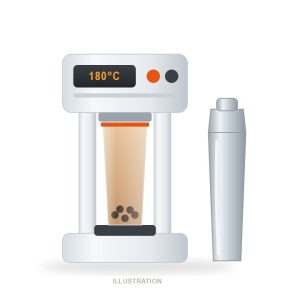
FAQ
How do I choose a cup sealing machine?
First make sure cup diameter, cup material and sealing film are compatible, then consider voltage, automatic or manual operation and repair service.
Why won’t my sealing film seal properly?
Common causes are low temperature, incompatible film and cup materials, or water, syrup or deformation at the rim.
Can PET cups be film-sealed?
It depends on the cup and film specifications, so follow the suppliers’ stated compatibility; PET cups commonly use flat or dome lids.
Can sealing film be printed with my brand?
Yes, custom printed film is available, usually with a minimum order quantity.
How do you use a cup sealing machine?
Generally: switch on and preheat to the set temperature, check the film is loaded the right way, place a cup of the matching diameter and start sealing, then check the seal is flat and leak-free; at closing, clean the heating plate as the manufacturer directs. Operation varies by model, so follow the manual.
What should overseas shops check when buying a cup sealing machine?
Besides matching the cup rim and material to the sealing film, check the destination’s voltage and plug type, whether local electrical safety certification is required, and how consumables and spare parts will be supplied. Tell the supplier your cup specifications and local voltage before ordering.
Further Reading
- PP vs PET Cups
- Bubble Tea Cup Sizes
- What Is a Tea Extraction Machine?
- Custom Printed Cups and Sealing Film
Sources
- Tang Sugar product list (March 2026 edition)

